


Do you think that once you finish university in Korea, you must immediately get a job?
Hi Guys, what’s yours’ thoughts on the question in the title? Last time, I shared some information about the Job-Seeking Activity Plan (구직활동계획서), which is a document you must submit to get a job in Korea. Because of that, many of you might think of the D-10 visa as a “visa exclusively for job preparation.” However, not everyone chooses the path of employment. Some may start their own business right after graduation. This time, for those of you who are thinking, “I want to start my own business in Korea with a D-10 visa,” I'll tell you how to prepare a Startup Activity Plan (창업활동계획서).
📌 The D-10 visa isn't just for finding a job.
Many people know the D-10 visa only as a "job-seeking visa," but it can also be applied for with the purpose of starting a business. This means you can legally start your own business in Korea without going through the process of getting a job after graduation. That moment of graduation can be the starting line of becoming a CEO, not just a time for job hunting.
📝✍️ What is a Startup Activity Plan(창업활동계획서), and how do you write it?
A Startup Activity Plan is not just a document where you write, "I want to start a business." It's a business execution plan that shows the immigration officer, "I don't just have an idea; I'm ready to execute it." In other words, think of it as a roadmap that transforms your idea into a realistic business plan.
Startup Item You need to describe exactly what product or service you will sell. Example: An IT app, a cosmetics brand, an online platform, educational content, etc.
Market Analysis You must show who your customers are, who your competitors are, and what your unique selling proposition is. It's a good idea to include supporting evidence such as surveys, statistics, and reports.
Execution Plan (6-Month Roadmap) Outline your activities for each month, step by step. Instead of abstract statements, include specific numbers and action-oriented goals.
Financial Plan You must include where you will get your funding and what you will spend it on. Clearly state the sources of funds, such as savings, family support, investments, or government grants.
Supporting Documents Attaching real supporting documents like patents, licenses, a business plan sample, a bank balance certificate, or a product sample will significantly increase credibility.
📅 Sample 6-Month Startup Activities
Month 1: Market Research & Idea Finalization
Industry Trend Analysis and Competitor Benchmarking: Review government statistics and reports, compare at least five companies (prices, services, customer feedback).
Customer Research and Idea Finalization: Conduct an online survey with 200 people and offline interviews with 20 people. Make a final decision based on market size and unique selling points.
Month 2: Business Model Detailing & Funding Planning
Business Model Establishment: Draft a business plan including customer segments and revenue structure.
Funding and Accounting Plan: Set up a funding structure from savings, family support, investments, or grants. Differentiate expenditure items (rent, labor costs, marketing expenses, etc.).
Month 3: Prototype Production & Promotion Channel Setup
Product Development: Produce a prototype or sample, and develop the brand identity (logo, slogan).
Promotion Channel Setup: Create a website and social media accounts, and prepare content (videos, posts, card news).
Month 4: Consumer Testing & Service Improvement
Beta Testing: Get feedback from at least 50 users through surveys and interviews.
Improvement and Networking: Enhance the product or service, participate in startup seminars and mentoring sessions.
Month 5: Investor Meetings & Partnership Discussions
Fundraising: Pitch to angel investors and accelerators, and apply for government support programs.
Collaboration and Marketing: Negotiate with distribution partners, and run social media ads and influencer collaborations.
Month 6: MVP Launch & First Customer Acquisition
Service Launch: Officially launch the MVP, secure the first customer contracts, and record initial revenue.
Expansion Preparation: Create a roadmap for improvements based on feedback, analyze profitability, and plan for additional investment and second-phase development.
💡 Pro Tips
Always include numbers and evidence. (e.g., 200 survey responses, 3 investor meetings).
Avoid vague phrases like "self-improvement" and use action-oriented language.
Prepare as many supporting documents as possible to gain the trust of the immigration officer.
🚀 Graduate and Start Your Business Right Away!
Following your dreams, finding a job isn't the only answer in Korea; you can also choose the path of an entrepreneur right after graduation. This Startup Activity Plan is not just a document for a visa; it's your startup roadmap. Use the D-10 visa to create a new beginning in Korea. 👉 If you're dreaming of starting a business in Korea, start writing your Startup Activity Plan right now. Your first journey as a CEO is about to begin!
If you have any more questions, feel free to leave a comment! 😉
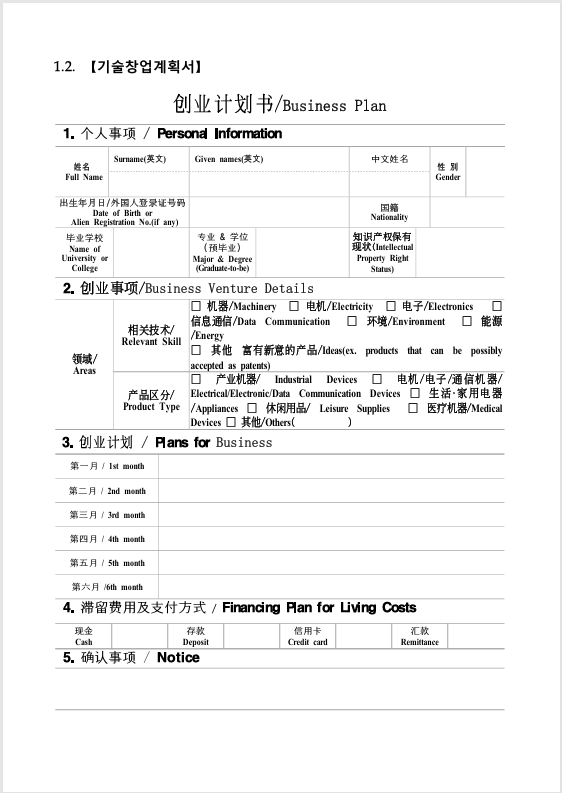
창업활동계획서 Image