


🤔🏠 What Are “월세,” “전세,” and “보증금” When Renting a Home in Korea?
Hi everyone, this is Vijob, your partner in navigating life's challenges! 👋
As you probably know, finding a place to live in Korea can be one of the most stressful experiences. When you're looking for a home here, you'll inevitably encounter terms like Wolse (월세), Jeonse (전세), and Boseunggeum (보증금). These concepts can be quite unfamiliar to foreigners, so what exactly do they mean?
Vijob is here to break it down for you, making it super easy to understand.
🔹 What is a “Deposit” (보증금) in Korea?
The Boseunggeum (보증금) is a fundamental amount of money in Korean housing rental contracts. Think of it as a large sum you entrust to the landlord for the duration of your lease in exchange for renting their property.
The general rule is that this entire amount is returned to you in full at the end of the contract. However, a portion might be deducted if there are any violations of the contract terms or damages to the property.
📌 Tip: Korean security deposits are typically much larger than standard security deposits in other countries. They can range from tens of millions to hundreds of millions of Korean Won!
🔸 What is “Monthly Rent” (월세)?
Monthly Rent (월세) is a rental system where you pay a security deposit plus a fixed monthly amount.
Security Deposit: Usually ranges from ₩5 million to ₩50 million.
Monthly Rent: Typically from ₩300,000 to over ₩1.5 million.
🟢 Pros:
Requires a relatively smaller upfront cost.
Generally easier to contract for short-term residents and foreigners.
🔴 Cons:
Involves a fixed monthly expenditure.
Can result in higher overall costs in the long run.
🔸 What is “Full Deposit Lease” (전세)?
Full Deposit Lease (전세) is a unique housing system found only in Korea. Under this arrangement, you don't pay monthly rent; instead, you make a large one-time security deposit.
Security Deposit Size: Typically 50-80% of the property's market value (e.g., ₩1.3 billion).
No Monthly Rent.
🟢 Pros:
No monthly rent payments, which can save you significant housing costs in the long term.
The entire security deposit is returned at the end of the contract.
🔴 Cons:
Requires a very substantial upfront sum of money.
Loans and contract conditions can be more stringent for foreigners.
There's a risk that the landlord may not be able to return the deposit.
🔸 What is “Semi-Deposit Lease” (반전세)?
Semi-Deposit Lease (반전세) is a hybrid rental type, falling between Jeonse and Wolse. You pay a large security deposit (similar to Jeonse, but usually less) and a smaller monthly rent.
Example: Security Deposit ₩80 million + Monthly Rent ₩300,000
🟢 Pros:
The upfront sum isn't as large as a full Jeonse, and the monthly rent is lower, spreading the financial burden.
A good option for those who find a full Jeonse too financially demanding.
🔴 Cons:
Still requires a tens of millions of Korean Won security deposit.
Given the larger deposit, more attention is needed to secure the deposit's protection.
✅ Summary Table
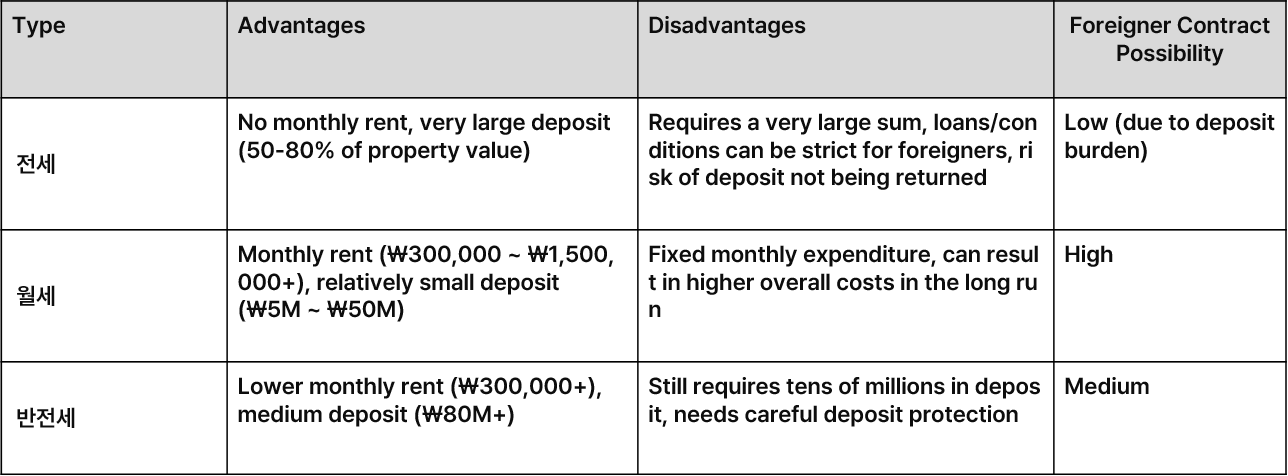
📌 Note: If your contract states "Security Deposit ₩XX / Monthly Rent ₩XX," it's either “Monthly Rent” (월세)or “Semi-Deposit Lease” (반전세).
📌 Note: If it only says "Security Deposit ₩XX / No Monthly Rent," it's “Full Deposit Lease” (전세).
Vijob's housing service provides not only this information but also other crucial details, all presented in an easy-to-understand way, helping foreigners secure reliable contracts.
📲 Find the perfect home for you on the Vijob App today!